Your Club’s Jersey is Canada’s History
We invite your organization to participate in a unique initiative, bringing together two pillars of Canadian identity: hockey and the legacy of those who served at Vimy Ridge. Read belowfor more details.
Contact us — whether your organization can participate — or if you would simply like to learn more. Contact us at:
secretary@baybloorcharitiesinc.org
We are happy to provide:
- A formal project brief and partnership agreement
- Details on the archival handling and return process for loaned jerseys
- Information on the street hockey training program and equipment needs
- Branding and recognition guidelines for participating clubs
From the Rink to the Ridge
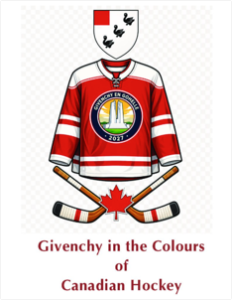
The project, “Givenchy aux couleurs du hockey canadien” (Givenchy in the Colours of Canadian Hockey), carries a powerful double purpose…keeping the memory of Vimy Ridge alive amongst Canadian youth while introducing French youth to the sport and culture of Canadian hockey.
The convergence of historical remembrance, athletic identity, and digital narrative construction represents a critical frontier for municipal organizations and cultural curators in the mid-2020s. As the global community approaches the 110th anniversary of the Battle of Vimy Ridge in 2027, the French municipality of Givenchy-en-Gohelle has conceptualized a transformative project entitled “Givenchy in the Colors of Canadian Hockey”.
This initiative seeks to bridge the chasm between the tactical complexities of the 1917 Western Front and the vibrant cultural tapestry of contemporary Canada through the medium of the hockey jersey—a garment that functions as a “living symbol of Canadian culture” and a “vector of transmission” between generations and nations.
The Givenchy 2027 Vision: An Integrated Framework for Immersive Commemoration
The municipality of Givenchy-en-Gohelle, situated in the shadow of the Canadian National Vimy Memorial, intends to undergo a radical spatial and cultural transformation by the year 2027. This strategic project is not merely an exhibition but a village-wide installation where official and symbolic jerseys from Canadian clubs will be staged across public spaces, building facades, and educational institutions.
The municipality’s formal request for donations or loans of vintage and current jerseys from organizations such as Hockey Canada, as well as professional and amateur clubs, underscores a commitment to authenticity and historical stewardship.
The ambition for 2027 is to transform Givenchy-en-Gohelle into an immersive space centered on hockey to honor the 110th anniversary of the Battle of Vimy Ridge. The project operates on the premise that the hockey sweater is more than apparel; it is an “identity card” and a symbol of national sovereignty. This educational dimension is paramount; by displaying these “textile artifacts,” the project aims to introduce local children to the nuances of Canadian culture and the sport that many of the “Byng Boys” played before arriving at the front in 1917.
Strategic Project Parameters for Givenchy 2027
| Programmatic Element | Description and Strategic Alignment | Targeted Outcomes |
|---|---|---|
| Urban Scenography | Deployment of jerseys on facades, in schools, and public squares. | Creation of a “Canadian enclave” in Northern France. |
| Institutional Partnership | Formal solicitation of loans/donations from Hockey Canada and NHL clubs. | Validation of the collection’s historical and cultural significance. |
| Archival Commitment | Guarantee of respectful handling and secure display with mandatory returns. | Long-term trust with major sports heritage organizations. |
| Educational Integration | Collaborative programs with local schools to raise cultural awareness. | Sustainable transmission of Vimy heritage to younger generations. |
| Digital Narrativization | Implementation of a robust WordPress platform to document the 2027 project. | Global reach and perpetual digital archiving of the anniversary events. |
The “Givenchy aux couleurs du hockey canadien” project utilizes the hockey jersey as a proxy for the shared history between France and Canada. Historically, the term “sweater” originated from the wool-knit coverings worn on frozen outdoor ponds—a necessity for warmth that eventually evolved into the high-performance uniforms of the modern era. By placing these symbols in the very streets where Canadian soldiers marched toward the ridge, the municipality creates a poignant juxtaposition between the “wool era” of the early 1900s and the “digital age” of the 110th anniversary.
Historical Infrastructure: The Rink-to-Ridge Connection
The connection between hockey and the Canadian military is not merely coincidental; it is foundational to the national psyche. In the early 20th century, the skills cultivated on the ice—endurance, physical toughness, tactical patience, and collective discipline—were viewed by the military as ideal preparation for the rigours of trench warfare. Many of Canada’s earliest hockey icons were among the first to volunteer for the Canadian Expeditionary Force (CEF). Allan “Scotty” Davidson, the captain who led the Toronto Blueshirts to their first Stanley Cup in 1914, became the first professional player to enlist in September 1914.
Davidson’s transition from a “smooth skater” and prolific goal scorer to a “bomb thrower” in the trenches illustrates the visceral reality of the era. He was killed by a shell explosion on June 16, 1915, and his name is now memorialized on the Canadian National Vimy Memorial. The psychological landscape of the trenches was frequently punctuated by the pursuit of normalcy through sport and correspondence. Soldiers often engaged in “uproarious nights” in the mess hall, using music and fellowship to maintain the “nerve” necessary for survival. Letters home from soldiers like George Stonefish of the Delaware First Nation or Lester Harper, a farmer from British Columbia, reveal the “sharp edge” of the war—where the proximity of death was so constant that men claimed they could “taste dead men in their tea”.
The Athlete-Soldier Nexus: Military and Athletic Service Profiles
| Player/Unit | Professional/Athletic Standing | Military Service and Role | Connection to Vimy/Remembrance |
|---|---|---|---|
| Scotty Davidson | Captain, Toronto Blueshirts (1914 Stanley Cup). | CEF Bomb Thrower; first pro player to enlist. | Memorialized on the Vimy Memorial. |
| Frank Thorsteinson | Star forward, Winnipeg Falcons. | 10th Battalion, Canadian Expeditionary Force. | Died of gas poisoning near Barlin/Vimy, 1918. |
| Red Dutton | Calgary Tigers defenseman. | Canadian Infantryman, Vimy Front. | Mangled leg by shell at Vimy; recovered to become NHL President. |
| Winnipeg Falcons | 1920 Olympic Gold Medalist core. | 223rd Battalion (Canadian Scandinavians). | Entire eligible roster enlisted; trained with Patriotic League. |
| Conn Smythe | Founder, Toronto Maple Leafs. | 40th Battery, Canadian Field Artillery. | Earned Military Cross for bravery; organized Battery hockey team. |
The Byng Boys
The “Byng Boys,” commanded by Sir Julian Byng, were renowned for their preparation and rehearsals. Byng, a British officer beloved by his Canadian troops, would later become the Governor General of Canada and Lord Byng of Vimy. The victory at Vimy Ridge, occurring between April 9 and 12, 1917, is frequently cited as the “birth of a nation” because it represented the first time all four Canadian divisions fought as a unified corps under a single objective. Tactical innovations, such as the “creeping barrage” masterminded by Major Alan Brooke and the use of the new 106 fuse, allowed the Canadians to succeed where previous French and British efforts had failed at a staggering cost of 150,000 casualties.
The Memorial Cup
The Memorial Cup, a cornerstone of Canadian junior hockey, traces its roots to the profound impact of World War I on national identity. Established in 1919 by Captain James T. Sutherland—a decorated military officer and passionate advocate for hockey—he envisioned the tournament as a tribute to both the fallen soldiers of the war and the emerging spirit of Canadian athletic excellence. Sutherland, who served as a key figure in the Canadian Amateur Hockey Association (CAHA), recognized the unifying power of sport during a time of national mourning, using hockey to bridge the gap between military sacrifice and civilian resilience. The inaugural event was held in 1919, featuring teams from Ontario and Quebec, and it quickly became a tradition that honored not only the military legacy but also the dedication of young hockey players across the country. This dual focus on remembrance and sport set the stage for the Memorial Cup to evolve into a symbol of national pride, blending historical reverence with competitive intensity.
The tournament’s structure and significance have grown over the decades, establishing it as the premier championship for junior hockey in Canada. Each year, the Memorial Cup brings together top teams from the Ontario Hockey League (OHL), Western Hockey League (WHL), and Quebec Major Junior Hockey League (QMJHL), representing the three major leagues of the Canadian Hockey League (CHL). The competition follows a rigorous format, beginning with preliminary rounds to narrow down the field, culminating in a final that determines the national champion. Beyond its sporting prestige, the Memorial Cup serves as a critical proving ground for future NHL prospects, with scouts from professional teams closely observing emerging talent. The tournament’s legacy is further solidified through its community impact, featuring ceremonies that highlight military service and local engagement, ensuring that each edition carries the weight of its historical purpose.
In the modern era, the Memorial Cup remains a dynamic force that honors both past and future generations of Canadian hockey. Recent editions have embraced technological advancements, including live analytics and digital fan engagement, while maintaining the tradition of honoring military service through dedicated ceremonies. Iconic moments, such as the 2019 championship where the Kamloops Blazers defeated the London Knights in a thrilling final, exemplify the tournament’s enduring ability to captivate audiences. Moreover, the Memorial Cup’s cultural significance is amplified by its role in inspiring youth, with schools and communities across Canada using the event as a catalyst for hockey education and patriotism. As it continues to adapt to contemporary trends while preserving its foundational values, the Memorial Cup stands as a living testament to the resilience of Canadian hockey and its deep connection to the nation’s history.
Next Steps
Contact us — whether your organization can participate — or if you would simply like to learn more. Contact us at:
secretary@baybloorcharitiesinc.org
We are happy to provide:
- A formal project brief and partnership agreement
- Details on the archival handling and return process for loaned jerseys
- Information on the street hockey training program and equipment needs
- Branding and recognition guidelines for participating clubs